The Silent Treatment

In my studio mining forty years of unfinished work and collected materials, I’ve set out to re-purpose the sluggish build-up.      

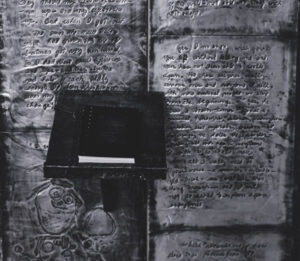
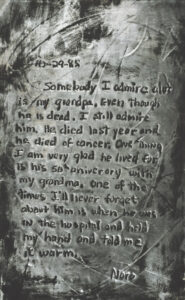
I have categorized piles. One is a stack of old found notes and drawings transferred to soft metal. Some of these are drawings by the disenfranchised people I work with in my socially engaged practice, some are domestic, didactic signs and directions found in the abandoned buildings or given to me.

A decade ago, a biology professor friend, Frank Jazsh, after cleaning out his office, left eight boxes of approximately two thousand out-of-print educational transparencies on the floor outside my office.  Two months later after retiring from teaching, he died of a heart attack while fishing his favorite trout stream in Yellow Stone.

I keep those transparencies close by on a table where I fiddle with my stacks and piles. Gradually I began intuitively layering the transparencies over the old metal notes creating a sort of investigation of those slippages and entanglements of language and visual experience through which we try to locate meaning. These layered worlds seem to explore the dualities and fluidity of identity, dislocation, and border crossings: substance/ absence, matter/spirit, microscopic/cosmic, poverty/privilege .

The search here is for some unspoken connection in these random collisions.

For me they embody the peculiar, ridiculous, and meaningful (less) qualities of most things human

Jane Gilmor: Statement August 2018

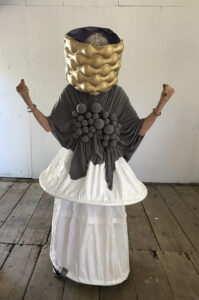
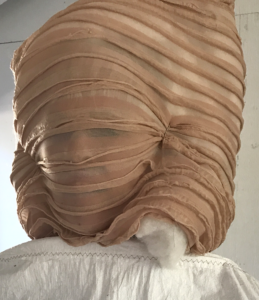
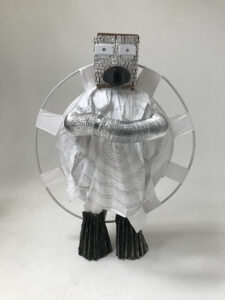
Two months ago, driving my little KIA back from a California residency, the Great Salt Lake appeared. Loaded down with a new series of wearable whatevers, I visualized dragging myself across this salt desert with a small band of women, all of us wearing versions of my latest getups.

Back home an email from Prompt inviting me to create a visual response to Rachel Yoder’s essay The Traditional Room.

An amalgam of cultural critique and intuitive response to personal experience, my Containers for the Self are wearable structures investigating those entanglements of image, language and space through which we try to locate our own identity. Depriving the wearer of touch, vision, and mobility, they explore the dualities of presence/ absence, public/private, poverty/privilege, or female/male through found materials and forms. The search is for some unspoken connection in these random collisions.

The following is Rachel Yoder’s essay “Prompt”:

Rachel Yoder

 The Traditional Room

The double skirt began as a regular, single, knee-length skirt, worn in the traditional manner in a traditional sort of room. However, there were those who came to object to such a skirt and the type of women who wore it. “They routinely hitch it up and pin the cloth to form abbreviated skirts,” the newspapers quoted. “It is waved to and fro in the manner of can-can dancers. See how the women flit on stage or sidewalk in their skirts with all parts of their bodies showing: their shins and the fleshy parts above their knee caps. Elbows. Their necks.” There was a great exodus of women to another room in which skirts were actually banned and alternative modes of clothing supported. There such things as parachutes, umbrellas, kites, flags, and sails flourished as forms of fashion.

However, back in The Traditional Room, the regular, single, knee-length skirt was legislated into a double skirt, two knee-length skirts worn at the same time, the outer skirt meant for the lifting and the covering of the face in moments of great blushing or fear or what have you. Some also viewed this as a gesture of piety or modesty, or pious modesty, and thus it became a religious act. Sects grew up in which the double skirt was worn continuously, pulled up round the faces of shy, pretty women. The act itself, however, of raising one’s double skirt was viewed by believers as overtly pornographic and so the upper skirt was raised privately before a pious woman went out, in her bedroom or perhaps even in the closet of her bedroom or even in the far recess of her long closet: this is where she took the hem between her fingers and floated it to her face and, in some cases, up over her head and down her back in a long veil. The double skirts grew.

Whole schools of women walked the streets dragging miles of cloth in their wake. On hot days, those prone to asthma or panic suffocated from the fabric pulling against their faces and then fell. Others crouched at their sides and felt for the heads of the fallen. The pious women could not see while wearing the double skirts but this, they felt, was a perfect sort of holiness. They pulled at the double skirts covering the faces of the women lying on the sidewalks until they could stand and breathe.

The double skirt swept up with it dead leaves and grass clippings, glinting shards of glass and lost earrings. Sometimes even small animals such as lice, flies, frogs, or grasshoppers were taken into the double skirts and at night, when the women pulled the skirts from their faces, the plagues were invoked in their bedrooms. Swarms ate holes through their wardrobes. They could not go out for fear of being seen. Others were left empty eyed on their beds, a barrage of flattened and rotting frogs at their feet. The walls moved with flies. Lice hid in their hair. Some had caught up the carcasses of birds and left streaks of brown blood in their sheets.

The schools of women on the streets thinned. Those who remained refused to remove the double skirts from their heads. Great sores formed on their faces and bodies from the rubbing. Others, on seeing the thinning of the schools, insisted on cladding their pets in double-skirts, and soon dead dogs and horses wrapped in lengths of fabric dotted the countryside. Pious hysteria became a diagnosable condition and various women were sent away to other rooms wherein they might receive treatments of moist, diaphanous cloths.

A rogue band of women became possessed of incomprehensible urges. They felt the times were slipping from them and, in an effort to regain control, crafted vast insurgent skirts which they used to control the weather, flying them from massive poles. Prevailing winds no longer prevailed. Great clouds formed and moved over land masses then dropped ice on the land. In a final statement, the rogue women launched skirts to space stations and deployed them over huge swaths of Earth.

Monstrous shadows which conjured monstrous mothers blinded The Traditional Room and other rooms both like and unlike it in darkness. De-greened wastelands spread. The Earth wore skirts of dust for many years, and the pious women migrated to these deserts. There, after many centuries, they discarded their double skirts and became naked, having forgotten their origins. They were not ashamed.


Rachel Yoder is the author of award winning novel Nightbitch, Doubleday, 2021, which has been translated into 14 languages. It was named best book of the year by Vulture and Esquire and recognized by the PEN/Hemmingway Award and shortlisted for the McKitterick Prize. She is a founding editor of draft: the journal of process which published first and final drafts of stories, essays, and poems along with author interviews about the creative process. Her essays and stories have appeared in The New York Times, The Chicago Tribune, The Paris Review Daily, and The Sun Magazine, among many other print and online publications. She directs literary programming for the Mission Creek Festival in Iowa City and holds an MFA in Creative Nonfiction from the University of Iowa as well as an MFA in Fiction from the University of Iowa.

In 2016-17, Champaign-Urbana faced a growing crisis in housing for low-income families and the under-sheltered. To bring this issue into sharper focus, The University of Illinois YMCA Art program, in collaboration The School of Art and Design and The School of Social Work, initiated BED SHOE HOME, a community-based art action collaborating with area homeless drop-in centers, domestic abuse shelters, and soup kitchens.

View the BED SHOE HOME powerpoint slides

As one component of year-long project, I was in residence on campus for the month of October (Domestic Violence Month). I worked with art and social work undergrad and graduate students to organize workshops at three area organizations: Courage Connection, operating a domestic violence emergency shelter and a women’s shelter, The Daily Bread Soup Kitchen, and The Phoenix, an area drop-in center.

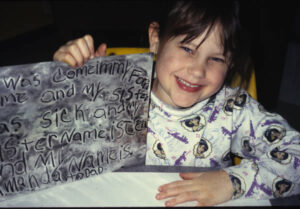
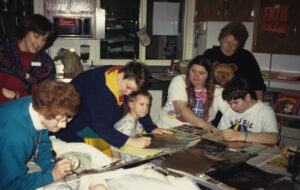
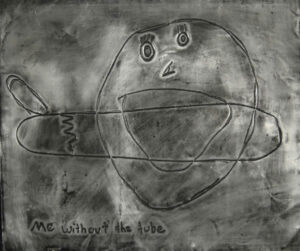
Discussion-based workshops with residents, staff and students in journaling, handmade books, and metal embossing as well as video and audio interviewing were part of a number of activities involved in this dialog between the University and those disenfranchised from it. During these workshops we created drawings and writings on metal foil based on visualizations and memories of a place. The place might be real or imagined, from past or present. Often in their representation of a place, individuals seemed to be dealing with a psychological space one might call “home” This socially engaged work explored identity, dislocation, and border crossings: poverty/privilege, public/private, rural/urban.

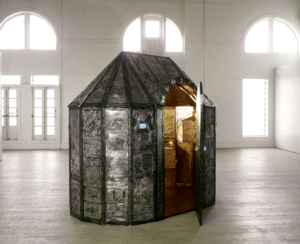
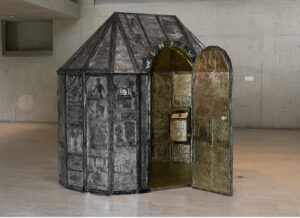
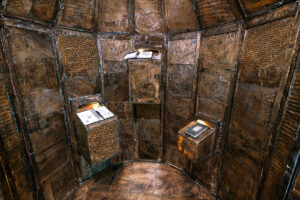
The project culminated in a three-month long participatory exhibition at the YMCA in which included a large walk-in book covered with images and writings on metal from participants and embedded with collaborating artist Matthew Butler’s video on homelessness.

BED SHOE HOME helped build a sense of community both within the under-sheltered population and between the University, the larger C-U community and those living on its edges. The project was also intended to give a voice to those marginalized and stereotyped in their own community while also providing participants access to nontraditional art forms and encouraging the use of imagination as a survival tool.

BED SHOE HOME was funded by The Institute for Advanced Study, George A. Miller Visiting Scholars Program, at the University Illinois Champaign-Urbana.

Download a list of resources on poverty and homelessness in Champaign/Urbana

Abandoned Quality Chef Building, Cedar Rapids, Iowa: Boni Cracker’s School of Under Cover Cooking Installation

As part of my New Genres class at Mount Mercy College each year we find an abandon factory, house or storefront site for the students to create site-specific installations. In 2006 and 2007 the city allowed us to use the former Quality Chef Frozen Soup factory and laboratory building in Cedar Rapids, Iowa. I collaborate with the students on this project, which culminates in a public opening with performances, video and other site-specific installations.

In 2007 I invited my long time colleague, friend and collaborator, Ann Gerber Sakaguchi in the San Francisco area (aka Bette Booda, Boni Cracker, etc) to get students involved in her latest project as part of the Quality Chef project. Ann had taken the altar ego of Boni Crocker and had started the Boni Cracker’s Instant School of Under Cover Cooking in response to the political climate in the years preceding Obama’s election. BCSUC, as it is known, has also served student in Chicago and in Ohio, where I assisted Boni by running her 2-hour degree program, administering lessons and diplomas.

On this page you first see Boni Cracker’s package, the school’s manifesto, admissions posters, admissions process, and a selection of the mail order lessons my students completed. The last Row of images shows several of the student installations in the laboratory and research division of the abandon soup factory in Cedar Rapids.

The Architecture of Migration, A Semester at Sea, and Morton’s Salt: Burnout all reference the psychology of personal and cultural migration a well as issues of mobility and consumerism in our post-industrial era.

The installation, A Semester at Sea, created for Maharishi International University in 2004, presents a five-foot long replica of a sailing ship painstakingly hand fabricated completely from burnt wood matchsticks. The ship was created by a school janitor and later given to me. On the floor surrounding the ship (from which a small pool of water oozes), are smaller artist made tables covered with hand sew ruffled metal tablecloths, each housing a small indented central pool of liquid from which a tiny metal book or a large cabbage emerges. The space is dimly light so the glossy grey tiled floor appears to be water. In one corner The Architecture of Migration towers above the scene reading from it’s various rotating texts.

Morton’s Salt: Burnout is a smaller installation from 2004. The piece centers around a small handmade Mexican wax candle (in the shape of a rose and referencing my mother) burns while rotating on a motorized disc on the wall. On the floor below, from my father’s childhood toys, is a miniature doll-sized fainting (psychiatrist’s) couch on wheel. Two tiny video monitors show close-ups of the same burning melting candle on the wall and a detail of two hands clapping. The video monitors appear to activate the floral rose-patterned fabric covering the couch. Nearby ceramic bisque-fired Morton’s Salt Girls (joined at the hip and meant to refer to my sister and I) stare at a large pool of white liquid.

My studio is in an old milk carton factory, the historic Cherry Building, in downtown Cedar Rapids, Iowa. I think of it not only as a place to work and think but also as its own kind of mutating installation, housing objects, text, video and audio portions from past works which I arrange in new juxtapositions at will. The space is always in flux but one area is reserved for creating new larger scale work, another for fiddling around with “stuff” and working on smaller things.

Part of my art practice, then, is simply the arranging of things to create new meanings. For 30 years I’ve collected found notes from family, friends, and strangers, which often become small metal drawings or books. I also collect “homemade” craft articles gleaned at flea markets and yard sales. These objects are meant to be based on a set of directions but the makers could not help altering the recipe. Materials from metal tooling foil to alphabet soup letters and burnt matchsticks are employed in these creations. Their originality and authenticity are a constant inspiration for me.

The totality of this work is extraordinary. It is my good fortune to have seen, touched and sensed this piece of art.

Ann Hamilton, artist, 4/20/99 Guestbook, Windows ’95, Des Moines Art Center)

Both Windows 95 and Wisdom Passage is were non-profit community arts projects intended to expose participants and the general public to one approach to what critic Arlene Raven has called new genre public art or art in the public interest.

Both projects are collaborative projects intended to give seriously ill hospitalized children or adults access to nontraditional art forms for personal expression and to encourage use of the imagination as both a survival tool and as a means for creating a psychological home away from home. It is my belief that art can help make meaning of one’s experiences, particularly when those experiences interrupt everyday life.

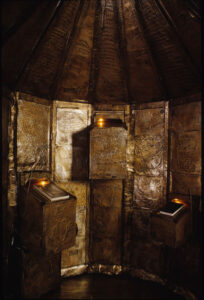
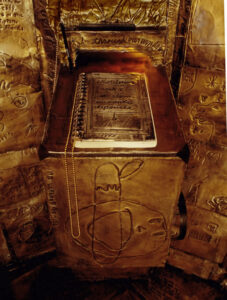
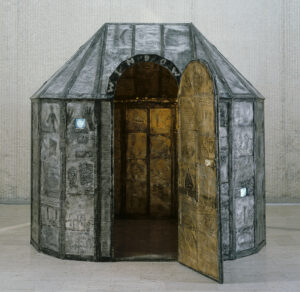
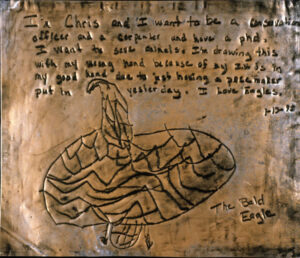
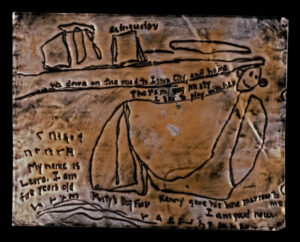
Windows 95 is owned by The Des Moines Art Center and was funded by a grant from The Iowa Arts Council and The University of Iowa Hospitals and Clinics. This collaborative work takes the form of a large, walk-in structure (built by artist Rick Edelman), covered inside and out with words and images on metal. In a series of weekly workshops over a one-year period, children from the Child Life Program of The Activities Therapy Department at the University of Iowa Hospitals and Clinics were invited to create images and writing related to their experiences, feelings and fantasies while hospitalized. Since UIHC is a state medical facility, children came from variety of economic and social backgrounds. The equalizer was serious illness. Monitors on the outside of the structure show video images, created by participants, of individual children looking out an imaginary window. Once inside the sculpture viewers are invited to contribute their own written stories, comment images. This work was is the lobby of the University of Iowa Hospitals and Clinics in Iowa City for two months in 1996.

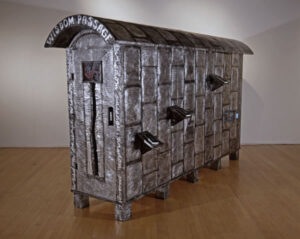
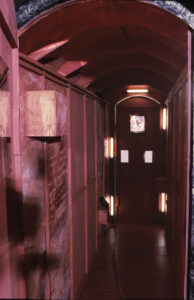
Wisdom Passage, 1996-7 is the result of collaboration between nationally known artists Jane Gilmor and Sandra Menefee-Taylor and oncology patients and their families from St. Paul/Minneapolis and Sioux City. In a series of workshops participants at St. Joseph’s Hospital in St. Paul were invited to keep journals concerning their experiences, feelings, and fantasies while struggling with serious illness. Writings and drawings selected from these journals by the participants were then transferred onto metal and plaster panels by Gilmor and Menefee-Taylor. The large bridge-like sculpture itself was designed by Gilmor and constructed by artist Rick Edelman. The videotape appearing on small window monitors was collaboration between Menefee-Taylor and award-winning Minneapolis filmmaker Kathleen Laughlin.

The Wisdom Passage Project was created in cooperation with the HealthEast Oncology Program in Minneapolis/St. Paul. Funding was provided by an Intermedia Arts/McKnight Interdisciplinary Artist’s Fellowship to Jane Gilmor. All participants are given extensive credit for their contributions. Any profits were used to help pay for uncovered costs of the project.

Thank you to all those who participated in both projects, many of whom have signed their work. Thank you also to those who have chosen to remain anonymous, but who are not forgotten.

4 inch square video of participant children looking out of tiny windows on the walk-in structure, video redone with actors in 2024.

In 1994 Lesley Wright, then curator for the Cedar Rapids Museum of Art invited me to have a solo show at the museum. Because I was heavily involved in community-based work with the disenfranchised in shelters across the country, I decided to combine my solo show with a project in Cedar Rapids working with the YWCA, The Madge Phillips Women’s Shelter and the McAuley Center for Women. Part of my goal was to get participants in both communities to cross borders. The YWCA and Madge Phillips Center were literally across the street from the Museum but neither group had visited the other’s space. My hope was to expose not only the shelter participants but also the community at large to new forms for art and the idea that use of the imagination can become a survival tool in extraordinary circumstances.

By creating installations involving all participants in both locations and providing free admission and transportation, I hoped to encourage the shelter participants to enter the museum and vice versa. The YWCA provided me with their Board Room and their large glass storefront for the installation there. The Museum gave me an entire floor and let me break a few rules. There was a gala opening at both venues and an active exchange of comments by virtue of a Thank You Shrine in the Museum where people could leave notes and “things” or take them.
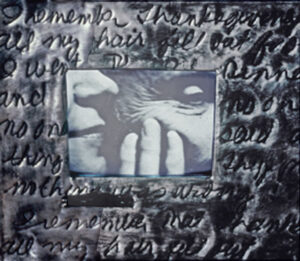
The idea of working with the contrasts of the privileged versus the disenfranchised had developed the year before while I was in residence at the Tyrone Guthrie Center Artist Colony in Ireland. My room and studio were in the Guthrie Mansion, where the halls and walls were filled with valuable artifacts. The irony of being paid a stipend to be in a beautiful place and work with my collected notes from homeless individuals resulted in my installation Ireland. I collected silver and gold artifacts from the hallway and library display cases and sat them on the floor of my empty room. Mounted on the wall above each was a 5″ x 7″ metal note incised with words or images from homeless adults and children. Under the window in the room I placed a long dinner table. On a ledge under the table I placed three white dinner plates, each with a large potato housing a 4-inch gas flame. On the table above, directly above each potato I placed a cross-shaped Kleenex box holder – one covered in living moss, one in rocks, and one with metal incised with love letters.

The 1994 exhibitions and events at The YWCA and the Cedar Rapids Museum grew from this concept and included continued references to beds, shelter and loss of identity. In particular, the YWCA Board room offered a site similar to the Ireland piece in that it housed the valuables of their collection and was designed with for the more privileged board members, but stood just down the hall from a shelter for abused women and children.

As her work has matured, Gilmor has continued to reflect on contemporary and developing feminist art discourse. As she and many other privileged American women artists consider their advantages, they have examined issues of the disadvantaged, as Gilmor has with her projects about and with homeless people. As issues of women’s identity have expanded to include the immigrant and the eroticized other, she has enlarged her practice to include collaborations, new combinations of sculpture, video/performance, her recent work, provides a good connecting thread to the contemporary practice of Midwestern American women artists and their present work on identity, process and labor, bearing witness to and questioning history.

Jayne Hileman, Professor of Art, St. Xavier University, Chicago, From the lecture: Women Artists At Work in Chicago 2000-2005

Home is Where…? Installations Bemis/Ireland

In 1992 The Bemis Center for Contemporary Art in Omaha, at the suggestion of collector Gregg Narber and Director Ree Schonlau invited me to fill their mammoth, gorgeous space in an warehouse facility turned exhibition space. The exhibit ended up being a mid-career retrospective with a small catalogue, coupled with a community-based project working with several area homeless shelters. The community-based Project, Home is where…? Was exhibited in downtown Omaha storefront and continued is the huge storefront at The Bemis Building. I basically lived in the gallery for a month to create the new pieces and install ten other smaller installations of my own work including Ireland, Wall of Found Notes and Objects, Beds, and The Homeless House.

Home is Where..? Work by Jane Gilmor. Bemis Center for Contemporary Art, Omaha, Nebraska, June 19 – July 31, 1993

by Hope Palmer

Tractor, Fall 1995 page 43 Reviews

Sometimes words are not enough to express the poignancy of human experience. Artist Jane Gilmor recreates in artistic form the panoply of experience that forms each of our lives. In these mixed media constructions, Gilmor never lets you forget the insurmountable capacity for hope contained within the human spirit.

Upon entering the gallery, one had the sense of being privileged to set foot in a world personally and secretly transcribed, a world at once contemporary, yet resounding with archetypal figures and situations. Here, in a series of 11 eloquent installations and sculptures incorporating found objects, metal notes, audiotape, videos potatoes, cabbages, messages from homeless individuals, is presented a haze of disestablished lives. Great care has been taken not to patronize those who have trustingly collaborated with the artist by allowing her into their lives.

Rarely is a viewer in a gallery situation made to be such an accomplice. It takes consummate skill on the part of the artist to project such immediacy of raw emotion. So much of this art deals with stolen moments of forgotten peoples forged from the real and from the imagination.

In Home is Where is …, a huge installation of found notes and messages from homeless individuals, transcribed on 36-gauge aluminum joined together with nails forming a patchwork metal wall, immediately confronted the visitor. Fascinated, one was drawn into the life-like environment where words and phrases slip in and out of meaning as our senses were overwhelmed by its huge scope.

In another installation entitled Wall of Notes and Objects, many of theses same images reoccur but this time not in tandem. On opposite walls, a 5 x7 inch metal sheet of incised text and a seemingly unrelated found object on a shelf form an immutable dialogue, marching in syncopated rhythm, isolated from one another by a good 15 feet, yet part of a mysterious whole. It is this sense of the mysterious that is a leitmotif throughout the rest of the pieces. They are approachable but just out of reach: and at first glance it seems as though we only view them through a dark and bitter light. But if we give the pieces some time, we find a cultivated richness, a sense of everyman’s family.

A savage intensity coupled with a mordant sense of humor is evident in two other pieces, three Beds (1995) and Ireland (1995). The first incorporates metal writing, moss, cabbage and small figures. In the second, religious and political affiliations are coupled with deadpan wit through the use of potatoes and Kleenex. Gilmor is an artist who is used to communication. She is currently a professor of art at Mount Mercy College in Cedar Rapids, The insight and skills used in teaching are a constant in her artwork as well. It is her observation of life, the ephemera of a world often given short shrift by those around her. that becomes noteworthy. Small transgressions become reformed in her eyes. reused in subversive ways. Her travels to such countries as Mexico, Greece, and Italy are incorporated into work that, in the final analysis, speaks of the spiritual permeating the fabric of all our entwined lives. The search for meaning in a life that takes many artists over the edge is here controlled with a refined sensibility and a fierceness that leaves unforgettable images in its aftermath.